
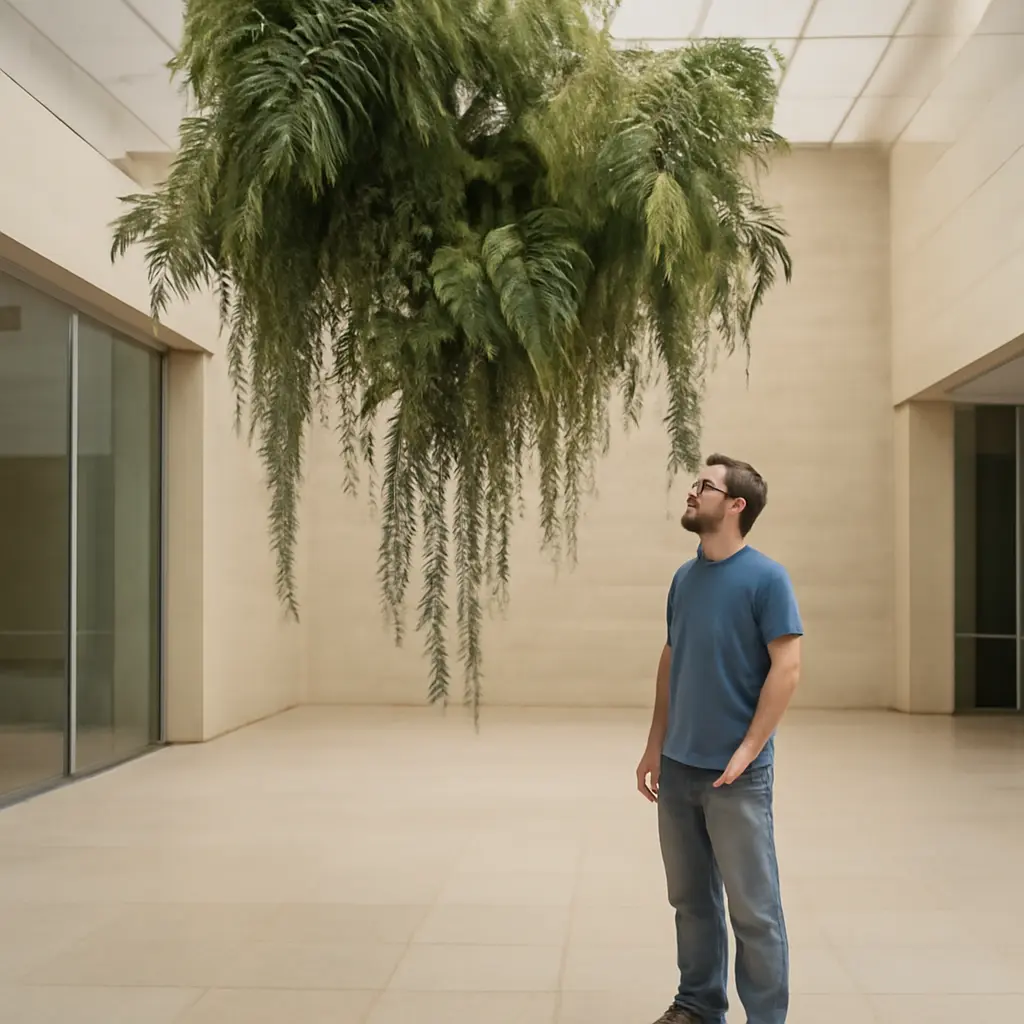
Hanging botanical installations turn ceilings, atriums, and other overlooked overhead spaces into immersive landscapes of plants, flowers, and foliage. By combining suspended greenery with thoughtful lighting, structure, and maintenance, designers can make ordinary venues feel like botanical dreamscapes while supporting visitor engagement and, in some cases, indoor comfort. This article explains how these installations are defined, explores their main forms and design principles, and reviews practical considerations and real-world examples. Their appeal is timely: the United Nations reports that 55% of the world’s population lived in urban areas in 2018, a share projected to reach 68% by 2050, increasing interest in bringing nature into built environments.
How Hanging Botanical Installations Transform Ordinary Venues
A hanging botanical installation is an overhead arrangement of living plants, cut flowers, preserved foliage, or botanical-inspired materials, supported by a ceiling, frame, cable system, or freestanding structure. The Royal Horticultural Society describes indoor plants as a way to bring nature into interior spaces, while the broader concept of biophilic design—popularized by environmental psychologist Stephen R. Kellert and colleagues—centers on connections between people and nature in the built environment. Hanging installations apply that idea vertically, turning unused airspace into a focal point without consuming as much floor area as conventional planting.
The installation’s impact depends on more than plant volume. Scale, sightlines, contrast, lighting, ceiling capacity, accessibility, and upkeep all shape the result. A lightweight preserved-moss canopy may suit a restaurant with limited daylight, while a living fern installation may work better in a bright atrium with irrigation access. The distinction matters: not every green-looking display is a living system, and claims about air purification or wellness should not be assumed without evidence specific to the installation.
Living plant canopies
A living canopy uses rooted plants suspended in containers, modular trays, or purpose-built frames. Species are chosen for the venue’s light, temperature, humidity, and maintenance capacity. Trailing plants such as pothos and philodendrons can create a cascading effect, while ferns and compact foliage plants can form denser overhead layers. Living systems need dependable watering, drainage, safe access for pruning, and a plan for replacing plants that decline.
The U.S. Environmental Protection Agency cautions that indoor air quality depends on multiple sources and ventilation conditions; ordinary potted plants should not be treated as a substitute for ventilation or source control. For designers, the strongest case for living overhead greenery is therefore aesthetic and experiential, with any environmental benefit assessed carefully rather than promised broadly.
Cut-flower and seasonal installations
Cut-flower installations use fresh stems, branches, and foliage arranged in suspended vessels or floral mechanics. They are well suited to weddings, launches, dining rooms, and short-term exhibitions because they offer vivid color and can be tailored to a particular season or event. Their short lifespan also creates operational demands: designers must account for water containment, replacement schedules, safe handling, and responsible disposal or composting where local systems allow.
Preserved and artificial botanical displays
Preserved foliage has been treated to retain its appearance without routine watering, while artificial botanicals are manufactured from materials such as fabric, plastic, or paper. These approaches can be useful where light, water access, or maintenance is limited. They differ substantially in material composition, durability, fire performance, and end-of-life options, so procurement should include product documentation and cleaning instructions. A preserved or artificial display should be described accurately rather than presented as a living garden.
How Design Choices Shape Hanging Botanical Installations
Once the installation type is selected, its design must connect visual ambition with building conditions. The most successful projects treat the arrangement as part of the venue’s architecture, not as a decorative object added after the fact. This means coordinating botanical choices with structural review, lighting, circulation, fire safety, and maintenance access from the beginning.
Scale, composition, and visitor experience
Scale refers to the installation’s dimensions in relation to the room, while composition describes how its forms, colors, and density are arranged. A broad, low canopy can create intimacy over a dining area; a narrow vertical cascade can draw attention toward a reception desk or stairwell. Designers should preserve clear paths, avoid obstructing signs and sprinklers, and consider how the display appears from multiple viewpoints, including entrances and upper floors.
Research on biophilic design commonly examines access to nature, natural patterns, and visual connections with the outdoors. A 2015 review by Human Spaces, drawing on a survey of 7,600 office workers across 16 countries, reported associations between workplace greenery and self-reported well-being and productivity. Such survey findings are useful context, but they do not prove that a particular hanging display will produce the same outcomes in every venue.
Lighting, climate, and plant selection
Light levels determine which living species can thrive and whether supplemental grow lighting is necessary. Temperature, humidity, air movement, and proximity to heating or cooling outlets also affect plant health. The University of Minnesota Extension recommends matching indoor plants to available light and care conditions; the same principle applies overhead, where access for inspection can be more difficult. For nonliving displays, lighting still matters because it reveals texture, casts shadows, and can make foliage look either natural or theatrical.
Suspension, safety, and maintenance
Suspension systems transfer the installation’s weight to a ceiling, beam, truss, or engineered frame. Structural capacity must be assessed for the complete installed load, including wet growing media, containers, irrigation, and possible water accumulation—not merely the dry weight of foliage. Venues should use qualified structural and fire-safety professionals, confirm local building requirements, and keep installations clear of egress routes, sprinklers, alarms, and required signage.
A maintenance plan should specify who inspects attachment points, waters and prunes plants, cleans fallen debris, manages pests, and responds to leaks or plant failure. For public venues, safe access equipment and scheduled inspections are essential. These practical measures protect both the display and the people below it.
Where Hanging Botanical Installations Work Best
Hanging greenery is adaptable because many venues have ceiling space that can be activated without rearranging their main floor plan. The appropriate format depends on how long the installation will remain, how many people pass beneath it, and how much care the site can support.
Hospitality and retail venues
Restaurants, hotels, and shops often use overhead botanicals to create a memorable arrival, frame a bar or dining zone, or distinguish one area within an open plan. A living installation can reinforce a venue’s connection to nature, while seasonal flowers can create a temporary event identity. In either case, the display should not interfere with food-service hygiene, customer circulation, lighting, or staff operations.
Events, atriums, and cultural spaces
Large atriums and event halls offer height and visibility that make suspended botanical features especially effective. The 2019 Singapore Biennale and other public arts programs have demonstrated how plants and natural forms can be used as immersive spatial elements, while large-scale floral events such as the Philadelphia Flower Show bring botanical design into exhibition settings. These examples illustrate a range of approaches, from temporary spectacle to curated environmental experience; each requires venue-specific engineering and visitor-safety planning.
A practical planning checklist
- Define whether the installation is living, cut-flower, preserved, or artificial.
- Confirm structural capacity and applicable building and fire-safety requirements.
- Map lighting, climate, irrigation, drainage, access, and maintenance needs.
- Protect circulation routes, emergency equipment, signs, and accessible clearances.
- Set a realistic budget that includes installation, inspection, upkeep, and replacement.
- Document materials and care instructions, and plan for reuse or responsible disposal.
Conclusion: Designing Botanical Dreamscapes Responsibly
Hanging botanical installations transform ordinary venues by using overhead space to create visual focus, atmosphere, and a stronger sense of connection with nature. Living canopies, seasonal floral displays, and preserved or artificial arrangements each offer distinct advantages, but their success depends on matching the format to the venue’s light, structure, safety requirements, and maintenance capacity. As urban populations grow, thoughtfully designed nature-inspired interiors can make shared spaces more inviting—provided that aesthetic claims are balanced with evidence and sound building practice. Venue owners and designers can begin by assessing the space, consulting qualified professionals, and choosing a botanical approach that can be maintained responsibly.
Sources: United Nations Department of Economic and Social Affairs, World Urbanization Prospects: The 2018 Revision, https://population.un.org/wup/Publications/Files/WUP2018-Report.pdf; Kellert, Stephen R., Judith H. Heerwagen, and Martin L. Mador, Biophilic Design: The Theory, Science and Practice of Bringing Buildings to Life, https://www.wiley.com/en-us/Biophilic+Design%3A+The+Theory%2C+Science+and+Practice+of+Bringing+Buildings+to+Life-p-9780470163344; U.S. Environmental Protection Agency, Indoor Air Quality, https://www.epa.gov/indoor-air-quality-iaq; Human Spaces, The Global Impact of Biophilic Design in the Workplace, https://greenplantsforgreenbuildings.org/wp-content/uploads/2015/08/Human-Spaces-Report-Biophilic-Global_Impact_Biophilic_Design.pdf; University of Minnesota Extension, Selecting Indoor Plants, https://extension.umn.edu/planting-and-growing-guides/houseplants; Singapore Art Museum, Singapore Biennale 2019, https://www.singaporeartmuseum.sg/our-programmes/exhibitions/singapore-biennale-2019; Pennsylvania Horticultural Society, Philadelphia Flower Show, https://phsonline.org/the-flower-show.